FrameworkDay 1·8 min read

What Is Go-to-Market?
(The Real Answer, Not the MBA One)

Found these gems on Reddit, still laughing out loud.
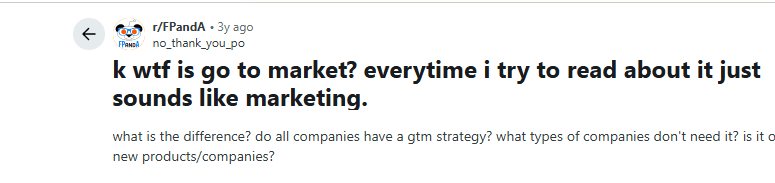
Reddit post: k wtf is go to market? everytime i try to read about it just sounds like marketing.
Reddit reply: In my company is used to refer to Sales.

I've been part of 10+ startups. Consulted for 50 more. And I can tell you one thing: the confusion isn't a joke. It's very much real.

Every article you read will tell you something different. Introduce 64 jargons and do nothing for you except leaving you more confused than you were before.

So let me try differently.


First — Let's Kill the Confusion

GTM is not marketing. GTM is not sales. Marketing and sales are parts of your GTM — like an engine and wheels are parts of a car. But neither one is the car.

Marketing

  • Creates awareness & demand
  • Ongoing — never stops
  • Builds the brand over time
  • Reaches the 95% not yet buying
  • Content, ads, community, SEO

Sales

  • Converts demand into revenue
  • Ongoing — never stops
  • Works the pipeline
  • Closes the 5% who are ready
  • Demos, calls, proposals, negotiation

GTM

  • The entire strategy — who, what, how, why
  • Specific to a launch or market entry
  • Coordinates product, marketing, sales, pricing
  • Decides which 5% to target & how
  • The plan that makes everything else make sense

Think of it this way:

Marketing is how you talk. Sales is how you close. GTM is why you're in the room in the first place.

Marketing and sales are always-on functions. They run continuously. But GTM is strategic and specific— it activates when you're entering a new situation:

1

New product → Existing market

An established clothing brand launching a line of beauty products. You have customers — but they don't know you for this.

2

Existing product → New market

A local SaaS tool expanding from India to SEA. The product works — but the market doesn't know you.

3

New product → New market

A startup launching its first app. Nobody knows you. Nobody knows the category. Maximum GTM risk.

Every time you enter one of these situations, you need a GTM strategy. Not a marketing plan. Not a sales target. A strategy— who are we selling to, why will they care, how will they find us, and what's the plan to make it all work together.


The Pattern I Keep Seeing

Across those 50+ startups I've worked with, the same movie plays out. You tell me if it sounds familiar.

A founder has a vision. They see a problem, they see the product that solves it. Clear as day. So they build.

Especially now, with tools like Claude Code, the building part is faster than it's ever been. So everyone's heads-down building — shipping features, perfecting the product, obsessing over the tech. Because that's the fun part. That's the part that feels like progress.

Without giving a singular thought to: "Who's our customer? How do we price this? Which channels do we use? This is the revenue target, doable right?"

And then the product is ready. It works. It's real. And nobody knows it exists.

That's when the panic starts.

A check-in with the VP of Growth: "We need to sell this product." Then a meeting with the salesperson: "Go get us $$$$$ in revenue."More often than not, these discussions start after the product is made. And that's even worse.

A startup I was consulting for came to me one day. They'd just built a new feature — something their competitors were shipping, something the market was buzzing about. They walked in with a revenue target and said: "This is the number we need to hit. Here's the feature. Now sell it."

I asked: "Who do you want to sell it to?"

Blank stares.

"Why did we build this feature?"

"Because everyone else was building it."

A feature built because competitors have it. No idea who it's for. A revenue target pulled from a board deck. And someone is supposed to "make it happen."

That's not GTM.

Work with me

I'm the person
founders and CXOs call
when there's no playbook.

Exploring a new market? Testing a new feature? Still figuring out ICP? I run 0-to-1 experiments with founders and turn pilots into wins.

So What Is GTM, Actually?

Strip away the jargon, and GTM is the answer to 5 questions:

WHO you sell to + WHAT you tell them + HOW they find you + WHY they buy + WHY they stay.

That's it. Answer these well, and you have a GTM strategy. Leave any one vague, and you're the founder in my story — building features because competitors have them and hoping someone figures out the rest.

1. WHO do you sell to?

Your ICP — Ideal Customer Profile. Not "everyone." Not "SMBs." Not "companies that need productivity tools." I mean specific enough that you can name 10 real companies and 10 real people within those companies.

Example: Razorpay's early ICP wasn't "businesses that need payments." It was "developers at Indian startups who are frustrated with existing payment gateway documentation."Hyper-specific. That's why it worked.

A broad ICP means broad messaging, which means you sound like everyone else, which means nobody pays attention. The startup that came to me with "sell this feature" couldn't answer WHO — and that's exactly where we began the work.

2. WHAT do you tell them?

This is positioning + messaging.

  • Positioning = Where you sit in the buyer's mind relative to alternatives.
  • Messaging = The actual words you use to communicate that position.

We're at a point where every company wants to be the "complete solution" or the "all-in-one platform." Half the founders I work with ask me to just slap AI somewhere on the homepage — "AI workflow," "the revolutionary way," "AI-powered this and that." That's not positioning. That's decoration. If everyone says the same thing, nobody is saying anything.

3. HOW do they find you?

Distribution. The unsexy part that makes or breaks companies.

Inbound

They come to you. SEO, content, word of mouth.

Outbound

You go to them. Cold email, LinkedIn, events.

Product-led

The product brings them in. Freemium, viral loops.

A decent product with great distribution beats a great product with no distribution. Every time.

4. WHY do they buy?

Not "because our product is great." People buy because:

  • Something hurts. A problem costing them time, money, or sanity.
  • Something changed. New regulation, new competitor, new boss, new funding.
  • Someone they trust said so. In India, this is MASSIVE. Reference selling drives more enterprise deals than any campaign.

The 95-5 Rule: Only 5% of your market is actively buying right now. Your job with the 5%: be findable. Your job with the 95%: be memorable for when they are.

5. WHY do they stay?

GTM doesn't end at the sale.

  • Activation: Do they actually start using it?
  • Expansion: Do they buy more over time?
  • Advocacy: Do they tell others? (This feeds back into Question 3.)

The best GTM is a loop, not a funnel. Funnels leak. Loops compound.


The 3 GTM Motions (Pick One)

Product-Led Growth (PLG)

Users try free, experience value, convert themselves.

Examples: Postman, BrowserStack, Figma, Calendly

The catch: Harder in India — higher support expectations.

Sales-Led Growth (SLG)

Reps find prospects, demo, close.

Examples: Darwinbox, LeadSquared, Freshworks enterprise

The catch: Expensive. Doesn't scale without bodies.

Community-Led Growth (CLG)

Build community around the problem. Earn trust. Then sell.

Examples: Zerodha, GrowthX, Notion

The catch: Slow. Months before payoff.

When companies are starting out, you reach out to founder friends, alumni, ex-colleagues, family. That's also GTM. That's network-based GTM — and honestly, that's usually the best way to start. Your first 10 customers will almost always come from people who trust you, not from a funnel.


The Real Cost

Across 50+ startups, the pattern repeats:

  • A feature gets built because the market is doing it — not because a customer asked.
  • A revenue target gets attached — pulled from a board deck.
  • Someone gets hired and told: "Make it happen."
  • That person spends 3-6 months figuring out things the founders should have figured out 12 months ago.

This kills more good products than bad tech, bad timing, or bad funding combined.

The Reddit user who asked "wtf is go to market?"was asking the right question. Most people inside companies can't answer it clearly either. And that's the problem.


Your Homework

Answer these for your product. In a note on your phone. Brutally short:

  1. 1WHO: One sentence — your most specific customer
  2. 2WHAT: Why you're different from the alternative
  3. 3HOW: Your top 2 distribution channels
  4. 4WHY BUY: The trigger that makes them need you TODAY
  5. 5WHY STAY: Why they can't leave after 3 months

If any of these are vague, that's your first problem. Not features. Not funding. GTM clarity.

Tomorrow — Teardown Tuesday

How Freshworks Went from Chennai Apartment to NYSE

The actual GTM moves — not the PR version.