If I Were Leading Product Marketing at Adbrew
A PMM's outside-in view of the company, the market, the product, and a GTM plan for taking AMC to market.
The market narrative: why Adbrew needs to exist.
As online shopping grew and more consumers moved to Amazon, more brands followed them there.
When more brands compete for the same shelf space, the cost of being visible goes up.
So Amazon introduced new ways for brands to stay visible. Which made things more complex. Then Amazon decided to introduce new ways to optimize that complexity. Which made things even more complex.
Each next phase of growth basically added the next phase of WTF.
Sponsored Products
The first ad format on Amazon. You picked a keyword, set a bid, and that was it.
Sponsored Brands
Banner ads started appearing at the very top of search results. Also ASIN / product targeting got introduced too.
Sponsored Brands Video
Video ads showed up right inside search results.
Sponsored Display
Twitch, IMDb, Fire TV, and third-party sites through Amazon Publisher Services.
Amazon DSP
Programmatic display and video advertising across Amazon's entire network became available.
Amazon Marketing Stream
Amazon started giving advertisers performance data broken down by the hour.
Amazon Marketing Cloud (AMC)
Amazon opened up a massive data clean room that can tell you if a customer saw your video ad on Tuesday, clicked a search ad on Thursday, and finally bought on Friday. The catch is that you need to write custom SQL code to access any of it.
AMC opens to all Sponsored Ads advertisers
Everyone has access to this incredibly powerful data now, but almost nobody knows what to do with it.
But wait. Amazon has its own ad console. Why would anyone need a separate platform?
01 / Amazon has to keep things simple for the 95%.
Amazon has millions of sellers. The vast majority of them are beginners, small businesses, or people running their first ecommerce store. If Amazon made their native dashboard complex with custom algorithms, dayparting schedules, and SQL coding environments, it would terrify 95% of their users. Those beginners would get confused, give up, and most importantly, stop spending money on ads.
This is what managing campaigns looks like inside Amazon's own console:
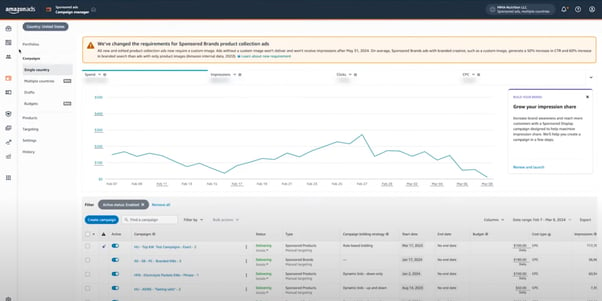
The campaign manager. Now imagine 500 campaigns here, each needing daily bid adjustments.
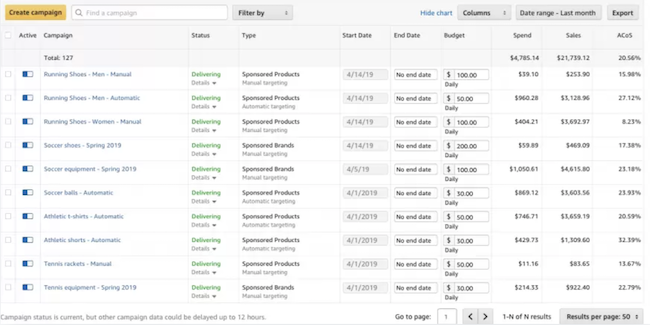
Managing a large catalogue. Every product needs its own campaign structure.
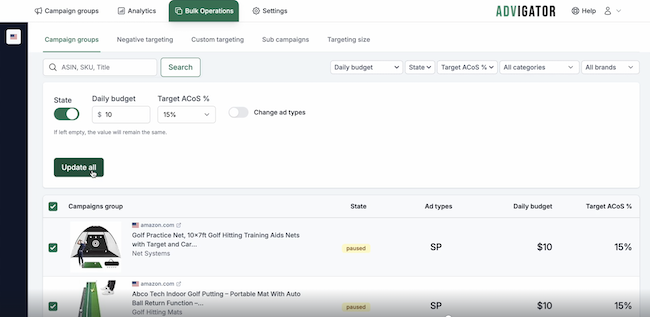
Bulk operations. This is how you make changes at scale. Spreadsheets.
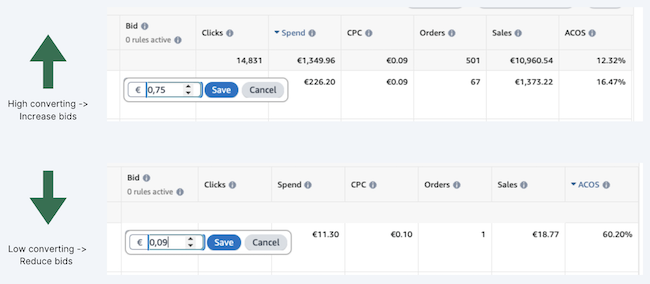
Adjusting bids. One campaign at a time. Multiply this by hundreds.
02 / The conflict of interest.
Amazon has no incentive to help you spend less. Amazon makes money every time someone clicks your ad. Their business model is built on you spending more, not spending smarter. The platform will happily let you burn through your budget on keywords that are not converting because that is still revenue for them.
03 / Platform > Product.
This is the core DNA of Amazon. If Amazon builds 10 template buttons in their dashboard, they now have to maintain those buttons. Amazon's philosophy has always been Platform over Product. They do not want to build a product, a dashboard, that they have to constantly update for angry marketers.
04 / Software companies are Amazon's free army of sales reps.
By allowing third-party tools to exist and thrive, Amazon essentially gets a massive free army of tech companies and agencies whose entire goal is to convince brands to increase their ad budget on Amazon. And then Amazon gives them Partner Awards for doing it well.
05 / The omnichannel reality.
Brands today do not just sell on Amazon. They sell on Walmart, Target, Instacart, and their own Shopify websites. Any major brand would want one single screen to manage all of their advertising across the entire internet. Third-party tools like Adbrew sit in the middle.
The tool landscape today, and the gap in the middle.
So brands and agencies clearly need tools to manage all of this. But the problem is that the market has split into two extremes, and there is nothing good in the middle.
Pacvue, Skai, Quartile
These platforms cost $5K to $10K+ per month. They are powerful, but they run on black-box AI where you never really know why your bids changed. They are built for Fortune 500 teams that have dedicated ad ops departments.
Helium 10, Jungle Scout
These are $39 to $229 per month. They started as product research tools and bolted on basic PPC features later. They are not built for serious advertising at scale.
| Platform | Segment | Pricing | Scope | Geo Focus | Positioning / GTM |
|---|---|---|---|---|---|
| Pacvue | Enterprise | Custom (~3% of spend) | 100+ retailers | Global (US HQ) | One dashboard for 100+ retailers. Enterprise sales-led. |
| Skai | Enterprise | $95K to $420K+ per year | Omnichannel | Global (Israel HQ) | Google + Meta + Amazon + retail in one platform. Enterprise sales-led. |
| Quartile | Enterprise | $895 to $10K + 2-5% | Multi-marketplace | Global (US HQ) | Patented AI optimization. Managed-service feel. |
| Intentwise | Mid-market | $500 to $1,500 per month | Amazon-primary | Global (India-origin) | Analytics brain. Data warehouse-led. |
| Perpetua | Mid-market | $250 to $550 + % of spend | Multi-marketplace | Global (Canada HQ) | Goal-based AI. Set targets, let AI optimize. |
| Teikametrics | Mid-market | $149 to $999 + 3% overage | Amazon / Walmart | Global (US HQ) | Inventory-aware ads. Retail + media unified. |
| Adbrew | Mid-market | $799 per month or % of spend | Amazon / Walmart | APAC-first, expanding global (India HQ) | Transparent automation + AI. Award-led credibility. |
| atom11 | SMB / Mid | $499 to $1,199 flat | Amazon-only | US + India (SF HQ, Bangalore ops) | Retail-aware copilot. Glass-box AI. |
| Helium 10 | SMB | $99 to $279 per month | Amazon / Walmart | Global (US HQ) | All-in-one seller toolkit. PLG. |
| Jungle Scout | SMB | $29 to $129 per month | Amazon-only | Global (US HQ) | Product research first. Ads secondary. |
The mid-market has been completely underserved. These are brands spending $10K to $500K per month on Amazon ads, and agencies managing 20 to 200 brand accounts. They need enterprise-grade automation, but they cannot justify enterprise prices. And more importantly, they want control. They want to see the rules, understand the logic, and trust what the tool is doing with their money. Black boxes do not work when you are spending real money and reporting back to real clients.
This is the gap Adbrew sits in.
Adbrew's brand story and positioning.
Origin
Ex-Amazonians who left and built the tool Amazon should have built but never will.
Credibility
3 Amazon Ads Partner Award wins across 3 consecutive years. Case studies published on Amazon's own website. Amazon's former Head of Strategic Partnerships joined the team in January 2025.
Traction
5,000+ brands and agencies. $250M+ annual ad spend managed. $1B+ in ad sales optimized. Bootstrapped. ~10 person team.
Product bet
Transparency. You see the rules, you understand the logic, you trust what the tool is doing with your money. Not a black box.
GTM
The credibility IS the GTM. Amazon insiders built it, Amazon validated it, and the ecosystem rewarded it.
Feature comparison: Adbrew vs. direct competitors.
Since most of the market is playing a different game, the real question is how Adbrew stacks up against the three platforms that are actually competing for the same customer. Here is a feature-by-feature breakdown.
Note: This comparison was co-authored with Claude based on publicly available landing pages which may themselves be outdated. Do not take it at face value. There may be errors.
Sponsored Ads Management
Amazon has four ad types: product ads in search results, brand banners at the top of the page, video ads inside search, and display ads that follow shoppers based on browsing history. Managing all four at scale is the baseline for any serious ad platform.
| Sub-feature | Adbrew | Intentwise | Teikametrics | atom11 |
|---|---|---|---|---|
| Sponsored Products | Yes | Yes | Yes | Yes |
| Sponsored Brands | Yes | Yes | Yes | Yes |
| Sponsored Brands Video | Yes | Beta | Yes | Not confirmed |
| Sponsored Display | Yes | Yes | Yes | Yes |
| Bulk campaign creation | Yes. Can launch hundreds of campaigns at once. The AI looks at your past performance and suggests what bids and keywords to start with. | Yes. Can create, edit, pause, and archive campaigns in bulk. | Yes. Their AI builds your entire campaign structure automatically across different stages of the buying journey. | Does not offer. Focused on optimizing campaigns that already exist, not creating new ones in bulk. |
| Automated keyword harvesting | Yes. Finds search terms that are converting and automatically adds them as keywords. Also breaks down search phrases word by word to find which specific words are driving sales. | Yes. Moves converting search terms into your campaigns automatically when they hit rules you set. | Yes. Automatically promotes search terms to keywords when they hit a certain number of conversions, clicks, and cost efficiency within a 30-day window. | Yes. Finds high-converting search terms and adds them to campaigns with the right match type and bid amount automatically. |
| Automated negative keywords | Yes. Identifies search terms that are wasting money and blocks them across multiple campaigns at once. | Yes. Uses rules you define to automatically block underperforming search terms. | Yes. Blocks search terms automatically when they spend above a certain amount without generating sales. | Yes. Automatically identifies and blocks search terms that are wasting your ad budget. |
Amazon Demand-Side Platform
Programmatic ads that run across Amazon's own network including Twitch, IMDb, and Fire TV. Usually requires a $35K+ minimum spend to access directly.
| Sub-feature | Adbrew | Intentwise | Teikametrics | atom11 |
|---|---|---|---|---|
| Full campaign management | Yes. Adbrew has their own access to the platform so you can create and manage everything directly through them without going to Amazon separately. | Yes. You can adjust campaign settings, budgets, and targeting without leaving Intentwise. | Yes, but only on their Advanced plan which starts at $1,430 per month. Not available on their basic plan. | Does not offer. You can build audiences and send them over, but you cannot create or manage the actual campaigns through atom11. |
| Minimum spend required | No minimum. Normally Amazon requires $35K+ to access this, but Adbrew removes that barrier. | No minimum. Intentwise also helps brands get access below the usual threshold. | You need to be on the Advanced plan ($1,430+ per month) to access this at all. | Not applicable since they do not manage campaigns. |
| Audience targeting | Yes. You can build custom audiences from Amazon Marketing Cloud data like people who added to cart but did not buy, or first-time shoppers, and use them to target ads. | Yes. Audiences you create from Amazon Marketing Cloud data automatically get connected to your campaigns. | Yes. Their AI automatically builds audience groups based on where shoppers are in the buying process. | Yes. You can create audience groups through their Amazon Marketing Cloud tools and then send those audiences to the platform for use. |
| Creative management | Yes. You can choose which ad creatives to use and track how each one is performing. | Does not offer. You need to manage your ad creatives directly in Amazon's own console. | Yes. Full control over ad creatives including images, videos, and copy within the platform. | Does not offer. Creative work happens outside of atom11. |
Amazon Marketing Cloud
Amazon's data clean room that shows the full customer journey across all ad types. Normally requires writing SQL code to access.
| Sub-feature | Adbrew | Intentwise | Teikametrics | atom11 |
|---|---|---|---|---|
| No-code access (no SQL needed) | Yes. You get pre-built reports you can run without any coding knowledge. | Yes. No-code reports for most users, but also lets advanced users write their own SQL queries if they want to go deeper. | Yes. No coding needed, but only available on the Advanced plan which costs $1,430+ per month. | Yes. Single-click setup. Reports are ready to run without any technical configuration. |
| Pre-built reports | Reports that show how a customer went from seeing an ad to buying, how long it takes people to convert, which combination of ad types works best, and how many customers are buying from you for the first time. | The largest library of ready-made reports in the market. You can also schedule them to run automatically on a set day and time every week. | 15+ ready-made dashboards that show things like which ad types overlap with each other, how customers move through the buying journey, and what the lifetime value of your customers looks like. | Reports covering the customer buying journey, how long it takes someone to purchase after seeing an ad, how many times someone needs to see an ad before buying, and which ad types are actually responsible for the sale. |
| Custom audience creation | Yes. Build groups of shoppers based on their behavior, like people who viewed your product multiple times but never bought, and target them with specific ads. | Yes. Can also upload your own customer data like email lists and find matching Amazon shoppers. Can build lookalike audiences that resemble your best customers. | Yes. The AI automatically creates audience groups based on real-time shopping behavior without you having to configure anything. | Yes. Build audiences based on shopping behavior with controls for how recently someone took an action. Can also build lookalike audiences. |
| Data refresh | Reports update automatically every day so you always see yesterday's data. | You choose how often reports refresh. Can set it to daily, weekly, or any schedule you want. | Not publicly specified. | Not publicly specified. |
| Custom SQL queries | Only available on the Enterprise plan. Standard users are limited to pre-built reports. | Yes. If you have a data analyst, they can write custom queries to answer any question the pre-built reports do not cover. | Does not offer self-service. Their expert services team can run custom analyses for you. | Does not offer. You work with the pre-built reports only. |
Rule-based Automation
Setting up if-this-then-that rules that automatically adjust bids, pause keywords, or move budgets based on conditions you define.
| Sub-feature | Adbrew | Intentwise | Teikametrics | atom11 |
|---|---|---|---|---|
| Custom if-then rules | Yes. Rules are set up like a decision tree where you can chain multiple conditions together. For example: if this keyword has spent more than $50 and made zero sales, lower the bid by 20%. | Yes. If two of your rules contradict each other, the system automatically figures out which one to follow instead of breaking. | Does not offer. There are no custom rules. You tell the AI your target cost per sale and your maximum bid, and it makes every decision from there. | Yes. Fully customizable. You can build any rule you want combining ad performance data with real-world product data. |
| What can be automated | How much you bid, how much you spend per day, where your ad appears on the page, which keywords to add or remove, turning campaigns on or off, and pausing ads when stock is low. | How much you bid, how much you spend per day, which keywords to add or remove, and turning campaigns on or off. | You set your goals and limits, the AI controls everything else. You do not define individual rules for specific actions. | How much you bid, how much you spend per day, which keywords to add or remove, where your ad appears, turning campaigns on or off, and time-of-day scheduling. |
| Pre-built rule library | Yes. Comes with a library of proven rules you can turn on immediately without building from scratch. | Does not offer. Every rule has to be created from scratch for your account. | Does not offer. No rules system at all. | Has bulk templates for time-of-day scheduling only. No general rule library. |
| Rules can use retail signals | Yes. Your rules can factor in things like whether your product is in stock, whether you own the Buy Box, or whether your price has changed. | Does not offer. Rules only look at ad performance data, not what is happening with your actual product. | The AI factors in retail signals behind the scenes, but you cannot create your own rules based on them. | Yes. Rules can combine ad data with 15+ real-world signals like inventory levels, competitor pricing, Buy Box status, and organic search ranking. |
AI-powered Automation
An AI layer that can launch campaigns, diagnose performance drops, and make optimization decisions without manual rules.
| Sub-feature | Adbrew | Intentwise | Teikametrics | atom11 |
|---|---|---|---|---|
| Product name | Adbrew Intelligence | No branded AI product. Machine learning runs in the background without a name or interface. | ARI (Artificial Retail Intelligence) | Neo AI Copilot |
| Conversational interface | Yes. You can type a question or instruction in plain English and the AI will act on it, like talking to an assistant. | Does not offer. The AI works silently behind the scenes. There is no way to ask it questions or give it instructions. | Does not offer. The AI runs automatically but you cannot interact with it through conversation. | Partially. It shows you analysis and explains its reasoning, but you cannot give it open-ended instructions yet. That is on their roadmap. |
| Campaign creation from prompts | Yes. You can describe what you want in one sentence and the AI will create hundreds of campaigns with the right structure, bids, and keywords. | Does not offer. | The AI builds campaign structures automatically, but you cannot give it a custom prompt. It decides the structure on its own. | Does not offer. |
| Root cause diagnosis | Yes. If your sales drop, the AI scans across all your campaigns to find what went wrong and explains it. | Can detect that something unusual happened, but does not dig into why it happened. It flags the anomaly, you have to investigate. | Does not offer. | Yes. Diagnoses performance drops in under 60 seconds by checking ad data alongside real-world signals like inventory, pricing, and competitor changes to tell you exactly what caused the drop. |
| Version control and rollback | Does not offer. | Does not offer. | Does not offer. | Yes. You can save a snapshot of your campaign settings before making changes, and if the changes do not work, you can roll everything back to exactly how it was before. |
Dayparting
Automatically adjusting your bids and budgets based on time of day. For example, spending more during peak shopping hours and pausing spend at 3 AM.
| Sub-feature | Adbrew | Intentwise | Teikametrics | atom11 |
|---|---|---|---|---|
| Hourly granularity | Yes. Can see and act on performance data for every hour of the day. | Yes. Can see performance data for every hour of the day. | Yes. Can set different bid adjustments for each hour of the day and each day of the week. | Yes. Can see and act on hourly data at the campaign, keyword, and placement level. |
| Auto-generated strategies | Yes. You tell it your goal and the platform automatically figures out which hours to spend more and which hours to pull back. | Does not offer. You have to look at the hourly data yourself and manually create rules for each time slot. | Yes. Their AI analyzes hourly data and automatically creates a schedule for when to increase and decrease spending. | Offers bulk templates you can apply across campaigns, but you still need to decide the strategy yourself. |
| What can be adjusted by hour | How much you bid, how much you spend, and where on the page your ad appears. All three can change every hour. | Only how much you bid. Budget and placement stay the same regardless of time. | How much extra or less you bid compared to your base bid. Setting it to zero effectively pauses your ads for that hour. | How much you bid, how much you spend, and whether the campaign is on or off. Can turn campaigns completely off during dead hours. |
| Combines with retail signals | Does not offer. Time-based adjustments only look at ad performance data. | Does not offer. Time-based adjustments only look at ad performance data. | Does not offer. Time-based adjustments only look at ad performance data. | Yes. You can create rules like “only increase bids during peak hours if the product is in stock and we own the Buy Box.” No other platform combines time with real-world product conditions. |
Share of Voice and Competitive Intelligence
Tracking how often your ads appear compared to competitors for specific keywords. Shows if you are winning or losing visibility on key search terms.
| Sub-feature | Adbrew | Intentwise | Teikametrics | atom11 |
|---|---|---|---|---|
| Keyword rank tracking | Yes. Tracks where your product ranks for specific search terms so you know if you are showing up on page 1 or page 5. | Yes. Checks rankings 4 times a day from different locations across the US to get an accurate picture, since rankings can vary by region. | Yes. Tracks your product visibility relative to competitors in their dashboards. | Does not offer a dedicated ranking tool. Competitive data comes through a separate Digital Shelf product powered by a third-party company called DataWeave. |
| Automated bids based on ranking | Yes. If your ranking drops on an important keyword, the platform can automatically increase your bid to win the position back. This is unique to Adbrew among these four. | Does not offer. You can see your ranking data, but you have to manually decide what to do about it. | Does not offer. | Does not offer. |
| Competitor monitoring | Yes. Shows each competing brand's share of visibility on your target keywords so you know exactly who is taking your space. | Yes. Tracks competitor presence with 13 months of historical data so you can see how competitive dynamics have shifted over time. | Yes. Competitor data is included in their unified dashboards alongside your own performance. | Available through Digital Shelf Analytics on the Professional plan ($1,199 per month) and above. Tracks competitive pricing and positioning. |
| Pricing note | This is a paid add-on. Not included in the base $799 per month plan. | Included in the platform at no extra cost. | Included in the platform at no extra cost. | Included on the Professional plan and above. Not available on the Beginner plan. |
Inventory-aware and Retail-aware Optimization
Connecting your ad spend to real-world retail signals like stock levels, pricing changes, Buy Box ownership, and bestseller rank so ads react to what is actually happening with your product.
| Sub-feature | Adbrew | Intentwise | Teikametrics | atom11 |
|---|---|---|---|---|
| Stock-out detection and ad pausing | Yes. If your product is running low on stock, the platform automatically stops running ads for it so you do not pay for clicks on something you cannot deliver. | Can see your inventory levels in reports, but does not automatically do anything about it. You have to notice and act on your own. | Yes. If your product is selling at a rate that will run out of stock in the next 14 days, the AI automatically pulls back ad spend to slow down sales before you run out. | Yes. Automatically pauses ads when a product goes out of stock or when margins drop below a threshold you set. |
| Buy Box monitoring | Yes. Monitors whether you are the seller that shows up in the main “Add to Cart” button. If you lose the Buy Box, advertising is usually a waste of money because the sale goes to another seller. | Shows Buy Box data in your reports, but does not automatically adjust your ads when you lose it. You have to catch it and react manually. | Yes. Buy Box status is connected to the ad strategy so the platform can react when you lose or win it back. | Yes. Buy Box ownership is checked continuously and factored into every single bid decision in real-time. If you lose the Buy Box, bids adjust immediately. |
| Pricing change detection | Yes. Monitors when your product price changes, which can affect how well your ads convert since a higher price usually means fewer people buy. | Shows pricing data in reports, but does not automatically adjust ads when prices change. | Yes. If your margins change because of a price shift, the platform adjusts how much it is willing to spend on ads accordingly. | Yes. Tracks competitor pricing and factors it into bidding decisions. If a competitor drops their price significantly, it can adjust your strategy. |
| Bestseller rank tracking | Yes. Tracks your product's ranking in Amazon's bestseller lists, which indicates how well it is selling relative to everything else in its category. | Yes, but only as data in your analytics dashboards. Does not connect it to ad decisions. | Yes. Bestseller rank is part of the unified retail data the AI uses to make decisions. | Yes. Bestseller rank is included in the retail analytics that feed into bidding decisions. |
| Organic cannibalization prevention | Yes. Detects when you are paying for ad clicks on keywords where your product already shows up at the top of search results naturally, so you are not wasting money on visibility you already have for free. | Does not offer. | Does not offer. | Yes. You can set rules like “if my product is already ranked number 1 in organic search results, reduce the ad bid by 50%” so you stop paying for a position you are already winning for free. |
Walmart Advertising
Managing advertising campaigns on Walmart's marketplace in addition to Amazon.
| Sub-feature | Adbrew | Intentwise | Teikametrics | atom11 |
|---|---|---|---|---|
| Walmart campaign management | Yes. You can create and manage Walmart ad campaigns with the same automation and rule-based tools you use for Amazon. | Yes. Intentwise is an official Walmart solution provider partner, which means they have a deeper integration and direct relationship with Walmart's ad team. | Yes. Also supports TikTok Shop in addition to Amazon and Walmart, making it the broadest marketplace coverage among these four. | Does not offer. Amazon-only platform. If you sell on Walmart, you need a separate tool. |
| Unified Amazon plus Walmart reporting | Yes. See your Amazon and Walmart ad performance side by side in one dashboard instead of switching between two separate platforms. | Yes. Can also track whether your Walmart online ads led to purchases in physical Walmart stores, which is something most platforms cannot do. | Yes. One view across Amazon, Walmart, and TikTok Shop so you can compare performance and allocate budget across marketplaces. | Does not offer. |
Analytics and Reporting
How deep the reporting and data analysis capabilities go. Ranges from basic dashboards to full data warehouses where you can run custom queries across all your data.
| Sub-feature | Adbrew | Intentwise | Teikametrics | atom11 |
|---|---|---|---|---|
| Custom dashboards | Yes. You can build your own views showing exactly the metrics you care about, with breakdowns by branded vs generic vs competitor keyword spending. | Yes. Through their Analytics Cloud product, which is essentially a full data platform where you can build any dashboard you want from your raw data. | Only on the Enterprise plan with custom pricing. Lower plans get pre-built dashboards that cannot be customized. | Yes. You can drill down into performance by individual product, campaign, or keyword to see exactly what is working and what is not. |
| White-label and shareable reports | Yes, but it is a paid add-on. Useful for agencies who want to send branded reports to their clients. | Yes. The strongest in the market for this. Agencies can set up a fully branded dashboard under their own domain name that clients can log into 24/7 with auto-refreshing data. | Yes. You can share performance dashboards with others. | Does not offer. If you are an agency that needs to send reports to clients under your own brand, you would need to build those manually outside the platform. |
| Data warehouse | Does not offer. Your data lives inside the Adbrew platform only. | Yes. A fully managed data warehouse starting at $1,500 per month where all your Amazon data is stored and can be queried, visualized, and connected to other tools. This is Intentwise's biggest differentiator. | Does not offer. | Does not offer. |
| External tool integration | Not publicly detailed on their website. | Connects to popular business intelligence tools like Looker Studio, Tableau, and Power BI so your team can analyze Amazon data alongside data from other parts of your business. | Standard integrations on lower plans. Custom API connections on Enterprise plan for teams that want to pipe data into their own systems. | Connects to Power BI for teams that want to build their own reports and analysis outside the platform. |
What users actually say about Adbrew.
“Adbrew helped us slash our ACOS by 31.97% in just two months, accompanied by a 17.55% increase in sales.”
Ron Puggi, Founder, Metrix
“Adbrew has saved us over 250 hours of manual optimization every month.”
Graeme Coyle, Founder, Seller Presto
“The best Amazon Ads software. Adbrew has all the features necessary for an agency to manage Amazon Ads campaigns efficiently.”
Mathieu F., CEO, Marketing & Advertising Agency · Capterra (verified review, 5/5)
“Their AI-driven solutions helped us cut ad spend by 30.86% while boosting total sales.”
Jitendra Rawal, Head of eCommerce, RENEE Cosmetics
“The possibilities of automation are at another level.”
Eric Vela, Marketplace Lab · JordiOB.com (verified review)
“We could automate repetitive actions and improve profit margins for multiple brands, while saving time.”
Anders Palmquist, Vice President & GM
AMC Deep Dive
Amazon Marketing Cloud: what it is, and why it matters right now.
Until recently, if you were advertising on Amazon, you could see that someone clicked your Sponsored Products ad and bought your product. But you could not see what happened before that click. Did they see your video ad three days ago? Did they browse your Sponsored Display ad on Twitch last week? Did they visit your product page five times before finally buying? All of that data existed inside Amazon, but Amazon never gave it to you.
Amazon Marketing Cloud changed that. It is essentially a secure data room where Amazon lets you look at the full picture of how customers interact with your brand across every ad type, every touchpoint, and every device, before they finally buy. Not just the last click. The entire journey.
The catch was that it required writing SQL code to access any of it. Not simple SQL either. Amazon has its own data structure, its own schemas, and everything is pseudonymized for privacy. So even if you had a data analyst on your team, they still had to learn Amazon's specific way of doing things before they could pull a single useful report.
For years, this meant AMC was effectively an enterprise-only tool. Only brands with dedicated data science teams or brands working with expensive enterprise platforms like Pacvue and Intentwise could actually use it. Everyone else knew AMC existed but could not do anything with it.
Then September 2025 happened.
Amazon opened AMC access to every single Sponsored Ads advertiser on the platform. Before this, you needed to be running DSP campaigns or have a special partnership to get in. After September 2025, millions of advertisers suddenly had the keys to the most powerful data tool Amazon has ever built.
At the same time, Amazon extended the data lookback window from 13 months to 25 months, plus 5 years of purchase history. They also started rolling out AI-powered SQL generation so you could describe what you wanted in plain English and the system would write the query for you. And they began expanding AMC to new regions including UK, Germany, France, Japan, and more.
Amazon is not treating AMC as a niche enterprise feature anymore. They are positioning it as a core part of the advertising platform that every serious advertiser should be using.
What can you actually figure out with AMC data?
Here are real examples of the questions AMC can answer that were previously impossible.
New-to-Brand Analysis
Are my ads actually bringing in new customers, or am I just re-advertising to people who already buy from me?
Before AMC
Sponsored Brands and Sponsored Display showed new-to-brand metrics, but Sponsored Products, where roughly 80% of ad spend goes, had none. No unified view across ad types, no breakdown by keyword or search term.
With AMC
68%
New
32%
Returning
Now you know if you are growing or just recycling.
What you do in Adbrew
- Build separate campaigns for acquisition vs. retention
- Set higher bids on keywords that bring in new customers
- Reduce spend on keywords that only convert existing buyers
- Track new-to-brand percentage over time to measure real growth
Path to Purchase
What does the customer journey actually look like before someone buys?
Before AMC
Search ad → Purchase
Last click gets 100% of the credit. Everything else looks like wasted spend.
With AMC
Video and display did the heavy lifting. Kill those and search stops converting.
What you do in Adbrew
- Reallocate budget towards ad types that start the journey, not just the ones that close it
- Stop cutting video and display budgets just because their direct return looks low
- Use the media mix report to find the right balance between ad types
Ad Overlap Analysis
Am I showing the same person too many ads? Are my ad types cannibalizing each other?
Before AMC
Each ad type reported in its own silo. You could be paying three times to reach the same person without knowing it.
With AMC
42%
Search only
35%
Search + display
23%
All three
What you do in Adbrew
- Identify which ad type combinations convert better and which just add cost
- Pull back display spend on audiences already converting through search alone
- Use frequency capping audiences in DSP to stop over-saturating shoppers
Time to Conversion
How long does it take someone to buy after they first see my ad?
Before AMC
Buy within 7 days? Yes or no.
Binary answer. No idea if they bought on day 1 or day 6. No idea what happened after day 7.
With AMC
38%
Day 0
24%
1-3d
22%
4-7d
16%
7-14d
What you do in Adbrew
- Stop killing campaigns after 3 days of “no results” when most buyers need a week
- Adjust dayparting and budget pacing to account for the real conversion timeline
- Run retargeting campaigns timed to hit shoppers during their peak decision window
Cart Abandonment Retargeting
Can I find people who added my product to their cart but never bought, and retarget just them?
Before AMC
DSP had basic cart abandoner segments, but no way to combine data points like recency, new-to-brand status, and ad exposure history into one precise audience.
With AMC
12,400
Found
Audience
Built
3.2x
Conv. rate
What you do in Adbrew
- Build a cart abandoner audience directly from AMC data inside Adbrew
- Push that audience to DSP campaigns without needing a separate tool
- Run targeted display ads with a specific message like a price drop or limited stock
- Track how many come back and convert
Customer Acquisition Cost
What does it actually cost me to acquire a brand new customer vs. re-selling to an existing one?
Before AMC
$9.50
One blended number. Looks fine. But you have no idea if you are spending $5 to re-sell or $20 to acquire. The average hides everything.
With AMC
$18.40
New
$4.20
Returning
4x difference. Changes everything about growth vs. retention budgeting.
What you do in Adbrew
- Set different target costs for acquisition campaigns vs. retention campaigns
- Accept higher cost per click on keywords that bring in new customers because lifetime value justifies it
- Track acquisition cost monthly as a core metric alongside overall ad cost
My AMC Go-to-Market Plan
If I were taking AMC to market for Adbrew, this is how I would position it.
The positioning.
Every platform in this space is selling AMC as a data product. “Get insights.” “See the full journey.” “Unlock clean room analytics.” Every competitor says the same thing.
The positioning I would build for Adbrew's AMC is different. It is not about data. It is about what happens after the data.
The narrative
AMC reveals how your customers actually buy, at the most granular level Amazon has ever made available. But that data is only as good as the decisions you take based on it.
Adbrew turns that precision into alerts, trends, and recommendations accurate enough that you can either act on them yourself or let automation drive them for you. So timely and so precise that the only outcome is better economics at every level of spend.
What this looks like in practice.
Before AMC-powered optimization, your notifications looked like this:
“Keyword ‘protein powder’ has spent $50 with 0 sales. Consider pausing.”
“Campaign budget is 80% spent. Consider increasing.”
“Your ad cost ratio increased by 5% this week.”
With AMC intelligence flowing into the system, the same notifications become:
“Keyword ‘protein powder’ has $0 in direct sales, but AMC shows it is the first touchpoint for 40% of customers who buy within 5 days through branded search. Do not pause. It is driving the funnel.”
“Campaign budget is 80% spent, but 72% of that spend is going to returning customers. Shift 30% of budget to your new-to-brand audience to improve acquisition.”
“Your ad cost ratio increased 5% this week, but your new-to-brand customer percentage went from 58% to 71%. You are spending more because you are growing. This is healthy.”
Who we go after, and in what order.
Not everyone needs AMC at the same time or for the same reason. The rollout should target three distinct segments, each with their own entry point and their own version of the pitch.
Brands already running DSP.
These brands were already part of the AMC world before September 2025 because DSP access was the old gateway. They know AMC exists. They may have tried it through Pacvue or directly through Amazon. But it was hard, expensive, or required SQL expertise they did not have. The pitch to them is not “here is what AMC is.” They already know. The pitch is: “everything you struggled to do with AMC before, you can now do without code, connected directly to your campaigns, at a fraction of the cost.”
How to find them: Adbrew already knows which customers use DSP through the platform. Start there. Externally, target brands that are listed in Amazon DSP case studies or that run programmatic ads on Twitch and Fire TV.
High-spend brands who have been flying blind.
These are brands spending $50K to $500K per month on Sponsored Ads. They have significant ad budgets but have never had access to AMC because it was locked behind DSP. They have been optimizing based on last-click data and gut feeling. They know something is missing but could never access it. The pitch to them is: “You have been making $500K per month decisions based on partial data. AMC is now available to you for the first time. We are bringing it to you before you even have to ask.”
How to find them: Adbrew can identify these by ad spend volume in existing accounts. Externally, filter by brands with high Sponsored Ads spend on Amazon but no DSP activity, which signals they never had AMC access before.
Agency partners with customer success at their core.
When every account manager has access to full customer journey data, new-to-brand splits, path to purchase analysis, and true acquisition costs inside the same tool they already use every day, the floor rises for the entire team.
The pitch to the agency owner is not about a new feature. It is: “Every account manager can now walk into a client meeting armed with new-to-brand numbers, true acquisition costs, and full journey attribution, and walk out with a happy and informed customer who knows exactly where their money is going and why.”
How to find them: Internal data. Existing agency accounts on Adbrew,
The phased execution.
Onboard 2 to 3 early adopters onto AMC.
AMC is new. There are no power users yet. So pick 2 to 3 existing Adbrew customers who have the right ad spend volume and the willingness to try something new. Offer a benefit program if needed, waived fees, priority support, co-marketing, or work purely on relationship. Set up their AMC instance, run the first reports with them, and document everything from day one. What did they believe about their ads before? What did AMC actually reveal? What decisions changed? This is not a case study yet. This is raw material.
Target ICP for pilots: D2C brands spending $50K+ per month with at least 3 ad types running. They have enough complexity for AMC to reveal something meaningful.
Teach people how to read and act on AMC data.
Brands know AMC exists. They know it is powerful. They also know it has been gated behind SQL and complexity. Adbrew removes that gate. But once the data is in front of them, most people still do not know what they are looking at or what to do with it. That is the education gap to own.
- Interactive demos of each AMC report type with sample data people can click through
- Templates for each use case: what to do when your new-to-brand ratio drops, what to do when ad overlap is too high, what a healthy path to purchase looks like vs an unhealthy one
- How to interpret each graph. What does a good time-to-conversion curve look like? What does a bad one look like? What action do you take in each case?
- Short video walkthroughs. Under 3 minutes each. Problem, report, interpretation, action.
- Co-hosted webinars with Amazon Ads team, agency partners, and brands who have seen AMC data firsthand. Let them tell the story, not us.
Build product-led entry points.
Let people experience AMC value inside the product or through a hands-on interaction before committing.
In-app: “Is AMC relevant for me?”
Lives inside the Adbrew dashboard for existing customers. Looks at their current account data and tells them whether AMC integration would make a difference for them or not. If yes, shows exactly which AMC reports would be relevant based on their ad types, spend level, and campaign structure.
- “You are running 3 ad types. AMC can show you how they overlap.”
- “Your conversion window suggests you are missing 40%+ of your attributed sales.”
- “Here are the 4 reports that would matter most for your account.”
Lead magnet: Free AMC Audit
For prospects not yet on Adbrew. They connect their AMC and get access to reports for 7 days to see if it adds value.
Decide on AMC pricing and packaging.
Three options on the table:
Option 1: Keep it as a paid add-on.
Safe for revenue but limits adoption. If AMC is the positioning, locking it behind a paywall means most customers never experience the thing you are positioning around.
Option 2: Freemium. Give 1 to 2 reports free for a limited number of days.
Better. Creates a trial window. But time-based trials create urgency without necessarily creating understanding. Someone might not get to their AMC reports in the first week and the window closes.
Option 3 (my recommendation): Show the recommendation, ask them to unlock the report.
Every Adbrew customer sees AMC-powered recommendations, alerts, and trends inside their existing dashboard for free. “68% of your sales this month came from new customers.” “Your video ads are the first touchpoint for 40% of purchases but get 0% of the credit in your current reports.” The insight is visible. The action is clear. But to see the full report, build the audience, or dive deeper, they unlock AMC. This creates the aha moment before asking for money. They do not pay for data they do not understand yet. They pay because they already saw what it revealed and want more.
Go to market.
Existing customers
- In-app activation: AMC relevance checker surfaces personalized recommendations inside the dashboard
- Email campaign: show each customer what AMC reveals about their specific account
- Webinars: co-hosted with pilot customers sharing what AMC changed for them
- CS-led onboarding: account managers walk customers through their first AMC report on a call
New acquisition
- Case studies: pilot results packaged with hard before and after numbers
- Free AMC audit: prospects book a call, get a real analysis of their account
- News angle: founder-led LinkedIn content tied to Amazon opening AMC to all advertisers
- ABM outbound: tailored messaging to each of the 3 target segments with pilot data as proof
- ABM ads: LinkedIn and programmatic targeting specific accounts. “Running 4 ad types on Amazon but only measuring the last click? There is a better way.”
- Testimonials: early adopter quotes embedded in landing pages, emails, and outbound sequences
- Sales enablement: one-pagers, pitch decks, objection handling docs, competitive battle cards
Recent discovery. Would recommend giving it a go regardless.
Success metrics.
Adoption (existing customers)
- AMC activation rate among existing customers
- Number of AMC reports run per account per month
- AMC-driven upsell revenue (free to paid conversion)
- Retention rate of AMC-activated accounts vs non-activated
Acquisition (new customers)
- Pipeline generated from AMC content, webinars, and audit tool
- Free AMC audit to paid conversion rate
- New customers acquired where AMC was the primary buying reason
- Competitive displacement wins from Intentwise, Teikametrics, atom11